
Dartmouth Accelerator Funds Teams Aiming to Improve Treatment, Quality of Life, For Cancer Patients
The sixth cohort of the Dartmouth Innovation Accelerator for Cancer (DIAC) awarded a total of $150,000 to two teams—one pursuing novel immunotherapy, and another developing a new tool for treating bone cancer.
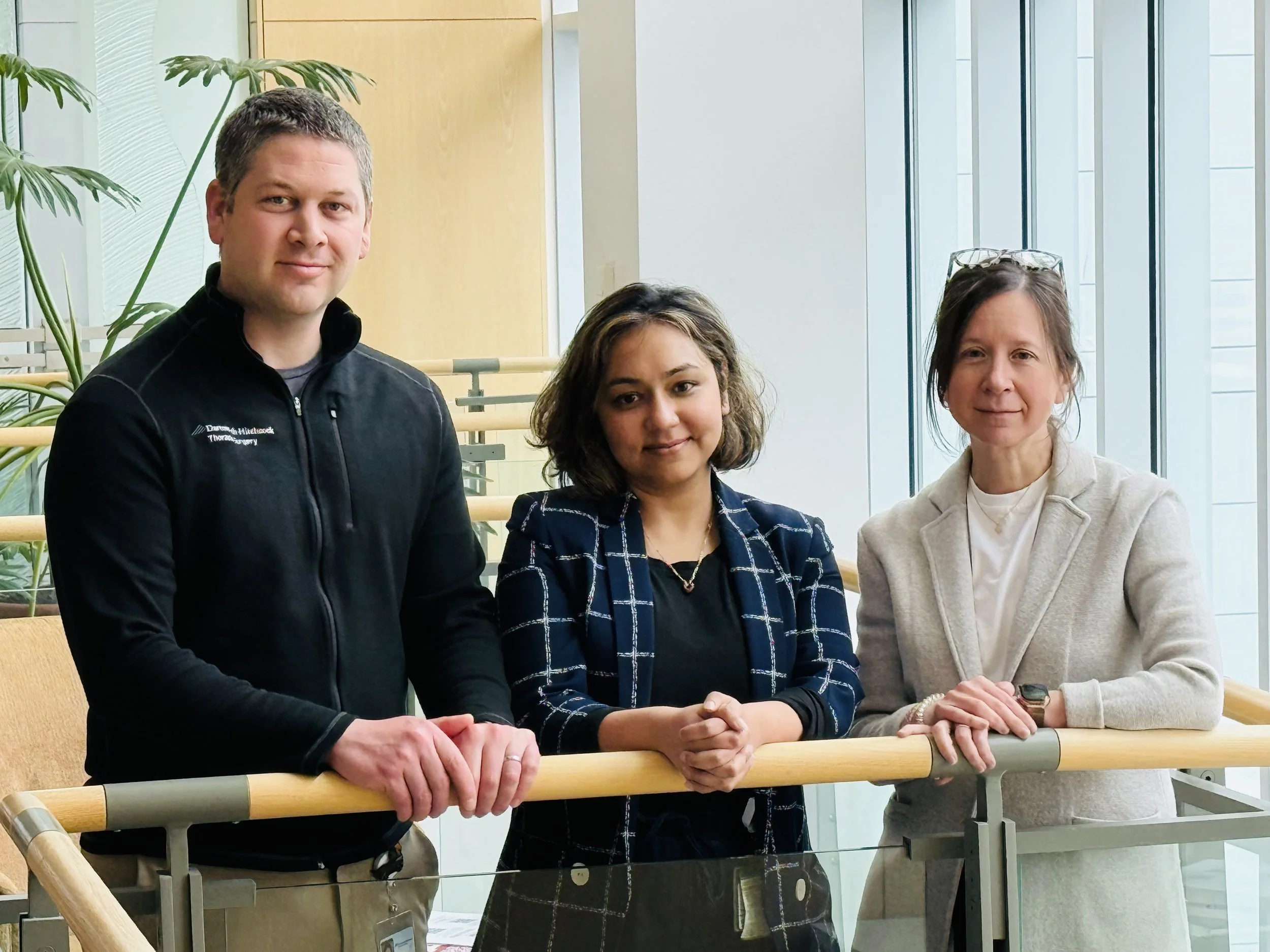
ResiMune Therapeutics team members Dr. Joseph Phillips, PhD candidate Neeti Mittal, and Dr. Mary Jo Turk
By Kelly Burch
Back in 2024, Dartmouth PhD candidate Neeti Mittal discovered a novel type of T cells in the lymph nodes that seemed to offer potent protections against cancer. Working in the lab of Dr. Mary Jo Turk, Mittal conducted tests showing the cells were able to control tumor growth in mice.
“We had generated data that was promising and really exciting,” Mittal said.
With that in hand, Mittal and Turk entered the 6th cohort of the Dartmouth Innovation Accelerator for Cancer (DIAC), held earlier this year by the Magnuson Center in partnership with The Dartmouth Cancer Center. Their team, ResiMune Therapeutics, joined nine other teams encompassing 47 individuals. The group met twice weekly to learn about bringing potentially life-saving biopharmaceutical innovations out of the lab and into the clinic.
During the final pitch competition in March, Mittal and Turk were awarded $100,000 to advance their project—funds they are now using to continue a push toward clinical trials. A second team, CryoMX—led by Dr. Katie Hixon and PhD student Aleyna La Croix—was awarded $50,000 to advance their technology: a conductive synthetic bone graft that could ultimately improve quality of life for patients with spinal cancer by allowing them to get continuous treatment at home.
“Being awarded the funding resulted in a huge progression of my confidence in the project,” La Croix said, “and my belief in where it can go from here.”
Advancing toward human trials, with DIAC funding
For the ResiMune Therapeutics team, funding comes at a critical junction.
“We’re not at a stage where we are competitive for grant funding because it’s high risk,” Turk explained.
This summer, Mittal and Turk will use the DIAC funding to conduct additional in vivo experiments. The data they gather, they hope, will eventually enable them to apply for an investigational new drug application (IND) from the FDA. They are now taking key steps to validate the efficacy of their therapy using mouse models and cells from cancer patients.
Gathering the necessary data prior to clinical trials is “really expensive,” Mittal said. “Now, we have the money to do it.”
La Croix plans to use her funding to prove her concept using animal models. At the same time, she’ll continue working with advisors she met through DIAC to determine which path to market makes the most sense for CryoMX.
Balancing science and business
The Dartmouth Innovation Accelerator Program launched in 2020, thanks to the generosity of alumni donors. Since then, the program has awarded more than $2.5 million in funding to help support the commercialization of Dartmouth innovations.
This year, ten teams were selected to compete for funding. Throughout January and February, participants met regularly with industry leaders who discussed protecting intellectual property, navigating the regulatory environment, creating a business plan, and attracting investment.
Having an acute focus on the business side of innovation was a shift for many of the scientists.
“When we are working in the lab, we’re not thinking about those things,” Mittal said. “DIAC put those aspects of bringing a technology to market into perspective.”
In addition to the educational sessions, teams were matched with mentors from the Tuck School of Business and Palamedes Partners, who helped them approach their technology with a business mindset. Even the professors learned a lot, according to Turk.
“We’re so focused on the science typically,” she said. “Learning about business was brand new and really valuable.”
The CryoMX team also had three undergraduate students, including Tatum Saunders D’28, who said DIAC showed her it’s possible to pursue a career that connects research and industry.
“It exposed me to both the academic and industry sides of biomedical research,” she said.
For undergrads, the focus on how scientific pursuits will ultimately benefit patients is particularly impactful.
“The students don’t get a whole lot of experience with the business side of things,” La Croix said. “This helped them see that what we’re doing in the lab is very translational.”
Benefits ripple out from the accelerator
La Croix previously participated in DIAC with another team that is also based in Hixon’s lab. That team had been through DIAC multiple times, which isn’t unusual—this year three of the teams were building on concepts that had previously been through the accelerator.
This year, participating with her own research, she came to DIAC at an earlier stage of innovation.
“It was nice starting from zero and creating a whole pitch deck,” La Croix said. Reviewing and refining her pitch deck weekly helped her to think about her company’s long-term trajectory.
She benefitted not only from the formal components of DIAC, but from the community the accelerator brought together. Angela Presley, Magnuson Center Program Manager for Accelerators, introduced La Croix to an FDA regulatory consultant who was able to discuss different pathways to regulatory approval. That was “extremely helpful,” La Croix said.
As the accelerator progressed, CryoMX clinical advisor, Dr. Eric Henderson, introduced La Croix to a patient advocate group (MIB Agents) focused on people with bone cancer. Through that connection, La Croix was invited to speak about her research on a panel at their summer conference.
“Having Aleyna recognized as contributing to emerging technology in this space is really exciting,” Hixon said. “The conference is an opportunity to really think about patient impact, but also to try and move this research into the public eye, which I think is very cool.”
A supportive community is at the heart of DIAC. Although teams were competing for funding, there was an air of collaboration throughout the accelerator.
“People really coalesced around helping the teams, even across labs,” Turk said. “That’s something you only find at Dartmouth. It’s just awesome that even in a competitive setting, Dartmouth people help Dartmouth people do better.”
About DIAC
The Dartmouth Innovation Accelerator for Cancer (DIAC) is a partnership between the Dartmouth Cancer Center and the Magnuson Center for Entrepreneurship that provides innovators across Dartmouth with the support, entrepreneurial guidance, and infrastructure needed to translate their cancer-fighting therapeutic, devices and diagnostics marketplace.
DIAC is a philanthropic initiative of the Call to Lead Campaign that launched in October 2020.
To date, DIAC has awarded more than $2 million in funding to advance scientific research, and teams have gone on to secure more than $17 million in funding. More than 300 faculty, staff, and students representing 73 teams have participated in the program, alongside faculty and staff.
DIAC accepts applications once per year from Dartmouth College and Dartmouth Health faculty-led teams working on cancer-related projects and provides these teams with co-curricular educational programming, mentorship, and funding to help them to evaluate and develop a commercialization plan for their innovations and harness the resources needed to accelerate the implementation of these solutions to improve people’s lives. Learn more here.