
Inaugural Healthcare Delivery Challenge Aims to Help Adults Age At Home
Dartmouth innovators worked to design a better home lift to assist with mobility. The winning design was awarded $70,000 to bring the concept to reality.
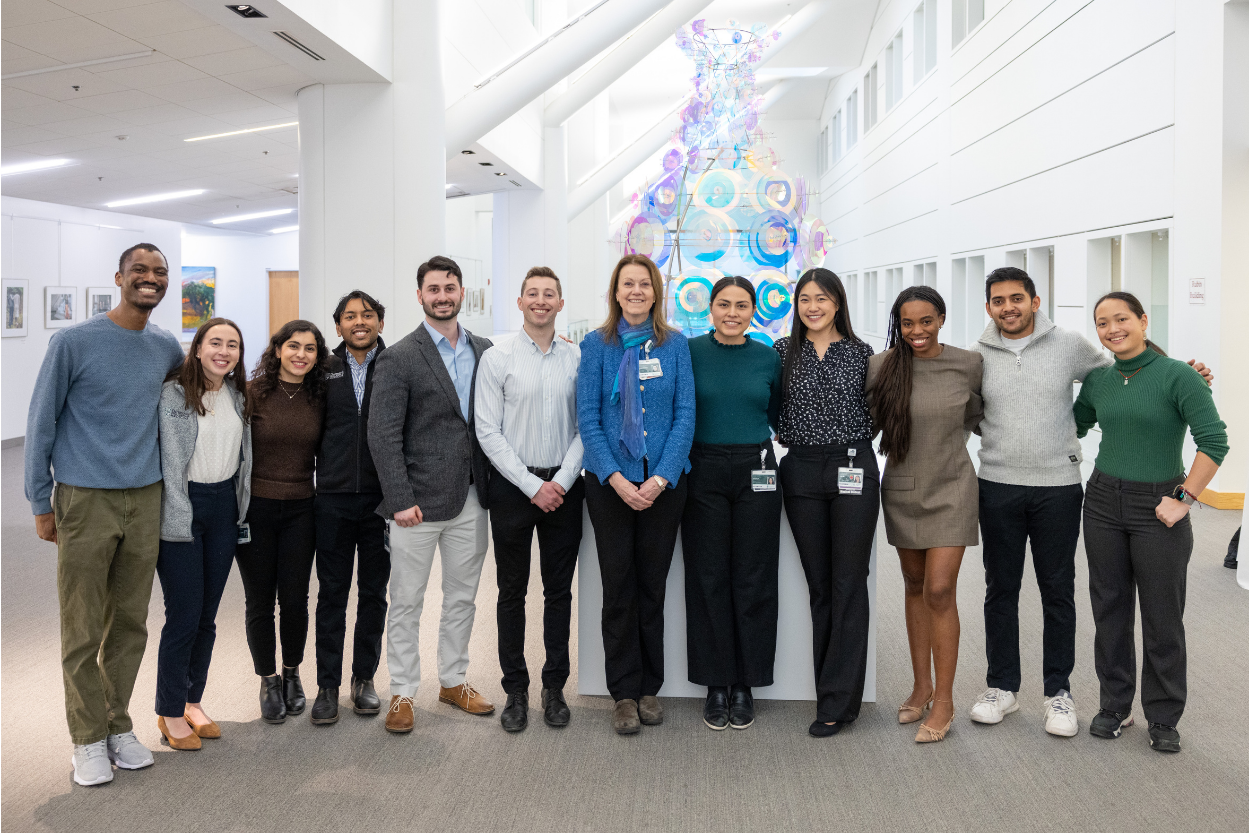
The Design for Health team members with Dr. Joanne Conroy, CEO of Dartmouth Health.
By Kelly Burch
Alec Fields, MD/MBA ’28, was inspired to go into medicine in part after watching his great aunt and uncle struggle in their old age.
“They didn’t have the opportunity to age independently and gracefully,” Fields says.
So, when he saw the prompt for Dartmouth’s inaugural Healthcare Delivery Challenge, he immediately understood why it was important. The challenge was simple, yet powerful: create a solution to help adults age at home, by safely moving them between their bed, a chair, and the bathroom.
“To improve quality of life, that’s right up our alley as a group,” says Fields, who led the challenge-winning Design for Health team along with Brizha Knowles, MD ’27. Knowles immediately recognized that innovations for moving people safely wouldn’t only benefit the elderly, but could also impact younger people, like her childhood best friend, who experienced a brain injury.
“This was such a special challenge,” she says, “because it also reminded me of one reason I got interested in medicine.”
A widespread and costly problem
In order to age in place—which the vast majority of people want to do—patients must be able to safely transfer from bed, to sitting, to the restroom. And yet, existing lift devices are too expensive and cumbersome for home use.
When patients and caregivers can’t safely transfer around the home, patients often end up in nursing homes of the hospitals, which is costly and often not the appropriate level of care.
“I can care for people much more effectively out in the community than I can in the hospital for less money,” Dr. Joanne M. Conroy, CEO of Dartmouth Health, noted at the kickoff event for the healthcare delivery challenge.
Funding for the challenge was donated by a Dartmouth Health physician whose family member was impacted by this issue. That’s all too common. At the kickoff event, Dr. Stuart D. Lewis, Associate Professor of Medicine at Geisel School of Medicine and geriatric practitioner at Dartmouth Hitchcock, pointed out that 40% of people will experience mobility issues by the time they’re 80.
That’s why many of the 25 participants in the challenge shared their own experiences with this issue.
“I'm not surprised by all of you who've mentioned some intimate, personal reason why you're here,” Lewis said.
Building a strong team
During the event—which kicked off in February—teams focused on three deliverables: their solution, the business strategy, and their project plan. Three teams were invited to a pitch competition, where they competed for $70,000 in funding to move their proposals forward.
Knowles and Fields relied on an extensive Dartmouth network, including faculty lead Dr. Alexander Abess, while designing their product, tentatively called “Lift Forward.” The duo co-lead the Design for Health club at Geisel, which aims to help physician innovators address healthcare concerns. Many of their team members for the healthcare delivery challenge were club members, though they also drew members from across the Dartmouth community, including the Tuck School of Business.
“When we won the competition the judges pointed out how amazing our team was,” Knowles says. “It’s a cross-disciplinary team that is passionate and committed.”
To ensure everyone involved really understood the problem, the team visited Cedar Hill nursing home in Woodstock, Vermont. There, they spoke with patients, physical therapists, nurses and doctors about what features did—and didn’t—work well in existing lift options.
Addressing two pain points
The solution they created aims to address two key pain points. Most existing mobility aids either serve people who cannot stand and need intensive support, or those who only need a small amount of assistance.
The Lift Forward device serves both those populations, by giving assistance to go from sitting to standing, and also allowing a caregiver to lift patients who can’t stand. With the dual applications, the device is better suited to address the real-world needs of patients.
“They might start their day able to stand up, but by the end of the day, be tired and need caregiver assistance,” Fields says.
The device also makes it easier for caregivers to position a patient on the lift. It has a split-seat system, allowing a caregiver to position the patient using only the device without needing to lift their entire weight.
Ultimately, the team was guided by a core question, Fields says: "How do we help the person in need and ensure it’s seamless for the caregiver?”
Now that the team has secured funding, they’re tapping even deeper into Dartmouth’s innovation ecosystem as they decide how best to move forward.
“We’ve gathered a list of people we’re having meetings with to get some advice and gain wisdom about the different paths we can take moving forward,” Knowles says. “It’s been really great to have that support.”
Fields adds, “We were incredibly fortunate to have the advisors we have, and the network that those advisors and the Magnuson center have created with us.”
A donor-issued challenge
This inaugural iteration of the healthcare delivery challenge was different from other accelerators that The Magnuson Center puts on, according to Angela Presley, PhD, Program Manager for Entrepreneurship at Geisel.
“Our other accelerators are focused on recruiting teams who already have an existing project within a certain vertical,” such as cancer treatment or digital health, Presley says. “For the healthcare delivery challenge, we were able to recruit teams who didn’t come to the table with a product idea, but instead had a personal connection to someone who has encountered this clinical issue.”
Because so many participants had experienced this issue first hand with their loved ones, “they were intrinsically motivated to find a solution,” Presley says. “This led to meaningful discussions and collaborative brainstorming during our sessions.”
In the future, Presley would love for other donors from within the Dartmouth community to issue their own healthcare challenges.
“I would love to see us continue to offer this type of programming periodically,” she says, “picking a different problem each time.”